
BLOG FOR ENTREPRENEURS

How Should Sellers Tie Employees to the Earnout?
If a meaningful portion of your purchase price is allocated to an earnout, one major question is how to ensure that your employees are incentivized to help you achieve it, particularly in deals where the Seller is not operating the post-closing business.
If a meaningful portion of your purchase price is allocated to an earnout, one major question is how to ensure that your employees are incentivized to help you achieve it.
One of the best methods is to find a Buyer who is willing to provide equity awards to your employees, as we saw in a trio of recently-announced acquisitions by Ondas Inc. (Nasdaq: ONDS). Ondas disclosed that it issued 37 separate awards to Seller employees, mainly RSUs and options. Most notably, the awards were time-based, with quarterly or monthly vesting over the next 2 years, largely coinciding with the 2-year earnouts in the 3 deals. This is potentially a massive boon to the Sellers.
In a deal where the Sellers are owner/operators who will stay in the business, those Sellers can retain meaningful control over the post-closing business and work toward the achievement of the earnout metrics. But, in situations where Sellers are not staying with the Target or joining Buyer, such as in a divestiture or platform sale, you are confronted with a divergence of interests: Seller's goals in achieving the earnout vs. the post-closing goals of the employees who will actually be running the business. Perhaps your earnout is based on net revenue or net income, whereas the employees are being incentivized to hit sales or revenue numbers. Or they may not survive the integration at all.
A Seller can tie-in those employees by signing letters at closing allocating a percentage of the earnout (e.g., 10%) to the employees. Or it can ensure that the employees' bonus and compensation packages are structured to harmonize with the earnout. But a separate tool, as we see in the Ondas transactions, is the Buyer equity package.
For Buyers, it may seem onerous considering that equity-based compensation is diluting your cap table, and is coming out of your pocket, rather than Seller's pocket. Yet, it sends a strong signal to Sellers that can help you win the deal. It potentially sends an even stronger signal to the employees that you want to integrate them into the long-term future of your business, perhaps extending the time horizon beyond the end of the earnout.
Sellers need every tool available to help achieve the earnout. Sellers who will not be part of the post-closing operations are particularly dependent on the efforts of the employees who are, truthfully, unlikely to care whether the Seller achieves the earnout. If your employees are disconnected from your earnout, their loyalty will be to themselves and their new employer, which could be the difference between a successful earnout and a failed one.
-Keith Bova

Employee Sentenced to 90 Months in Prison in Galling Insider Fraud
A recent conviction of a malicious employee shows, yet again, how SMBs can be targeted and victimized by their own employees.
A recent conviction of a malicious employee shows, yet again, how SMBs can be targeted and victimized by their own employees.
In April, an employee in a Missouri-based company, Tera Enterprises, was sentenced to 90 months in prison for embezzling $3.82 million from her employer. The employee, Bridget Thebeau, pleaded guilty to five counts of wire fraud.
The employer was a small, family-owned business. Thebeau had been hired out of college, and promoted from within the business to a senior role, paying her 6 figures and allowing her to work from home. As the business owner began shifting toward retirement, Thebeau began colluding with the company's Chinese suppliers. Over the course of 9 years, she orchestrated a procurement fraud scheme, replete with inflated purchase orders (over 150) and fictitious orders (over 80), causing her employer to pay $3.82M for products that the company neither received nor needed. The Chinese suppliers kicked back more than half of this money back to Thebeau over the 9-year period.
To hide her scheme, she created fictitious shipping labels, and provided fictitious invoices to her owner and their outside accountants to make it appear that customers were purchasing the fake products. Then, when her fraud was discovered, she deleted records from the company's servers and cloud, deleted evidence from her phone, and submerged her laptop in a sink full of water. At her sentencing, the judge called it one of the worst embezzlement schemes he had seen in his time on the bench.
Ultimately, the owner was forced to come out of retirement, and sell off assets to help the company avoid bankruptcy. He sold the company's office building of 20 years, and had to cause the company to take on debt. The company's customer, banking and other relationships were severely damaged. The case serves as a stark reminder about the need for separation of duties and other controls, even within smaller, family-owned companies. Thebeau has been ordered to repay the $3.82M, but defendants in these cases rarely satisfy restitution orders in full, leaving the defrauded employer holding the bag.
Keith Bova

Do You Need Your Lawyer's Help With the LOI?
You should definitely enlist your corporate counsel to help you prepare the LOI (buy-side), or at least review it (sell-side). We don't do what you do (build and scale businesses), and you don't do what we do (cover you on the legal front).
Selfishly, I would say yes, you should definitely enlist your corporate counsel to help you prepare the LOI (buy-side), or at least review it (sell-side). Obviously. I don't do what you do (build and scale businesses), and you don't do what I do (cover you on the legal front).
Then again, lawyers are expensive. And, so the thinking goes, "it's just an LOI." You can get the lawyers involved LATER, right? This is prevalent thinking, especially on the sell-side. Plus... you can run the LOI through ChatGPT. What are you really even giving up? It depends on your lawyer. It depends on your Buyer. And it depends on your deal.
In truth, a number of my clients will email me a signed LOI as my first involvement in the deal. Some of my favorite clients do this, no less 🙆. I trust them, and the usual arrangement is that the Buyer is also agreeing to exclude the lawyers. Until "after the LOI is signed." Which is only half-true. The LOI is a template from a past deal, that the lawyers prepared for that deal, and still contains numerous points that Buyer's attorneys will drop into an LOI. So, a "no lawyer" LOI will have your mix of Buyer-friendly items like 1-way working capital adjustments, limited or no earn-out covenants, no mention of "Good Reason" protections for if Seller's senior executives get pushed out early, and long exclusivity clauses. And a template LOI will probably have legacy terms from Buyer's last deal that are inapplicable to this deal, like an outdated indemnity concept that was specific to the last Seller but is irrelevant (or harmful) to you.
I know, I know. Very self-serving for the lawyer to write this. Easy enough for me to say that you should at least let me spend an hour or two with the draft LOI, to issue spot, or run it through CoCounsel, or jump on a Zoom to give you some talking points for your negotiations. I mean, it's only the sale of your business. What's a million here, or a million there?
But, seriously, it's fair for you to talk to your lawyer upfront about timing and estimates. So that you're getting actual value. Yes, an LOI is largely non-binding, but it is also the case that parties become much less likely to re-trade an issue that was agreed in the LOI if they shook on it. A tight but thorough review of the LOI helps you avoid agreeing to things you weren't aware of, and gives you credibility in the negotiations to come.

A Tale of Two Earnouts
We spotted a pair of recent SMB/lower-middle market deals in the news. Both had useful nuggets buried in their earnout clauses.
We spotted a pair of recent SMB/lower-middle market deals in the news. Both had useful nuggets buried in their earnout clauses.
The first: AirJoule Technologies Corporation acquired Bitsink LLC, a manufacturer of cooling, power distribution and racking infrastructure for AI and high-density data centers. Bitsink was paid $18M in upfront cash (subject to adjustment/holdback) as well as $9M in Buyer's NASDAQ-listed common stock. Further, Buyer agreed to issue up to a maximum of $40M in additional stock over a 3-year earnout. With only 40% of proceeds paid at closing, there is extraordinary weight on the earnout.
Buyer disclosed that Seller's revenues were $11M across 2024-25 (combined). On those figures, the $27M in upfront proceeds implies an approximately 5x revenue multiple (average), assuming similar 1H 2026 numbers. Perhaps more interesting is that the earnout targets are revenue-based, where Year 1 requires approx. $30M to hit the maximum earnout ($20M) and Year 2 requires approx. $63M to receive the 2nd tranche ($20M), with a 3rd earnout year for catch-up. Those are lofty targets. Buyer also reported that Seller headed into closing with $15 million in near-term purchase orders.
For Seller, you have to applaud the chance at $67M in total proceeds (max) on pre-closing revenues averaging $6M/yr or less. Yet, the structure points to numerous warning signs, such as a low cash-to-stock mix, which is especially concerning given Buyer's profile (recent SPAC). When focusing on the earnout, again you would applaud Seller's negotiation of a revenue-based set of targets rather than murky EBITDA or margin targets that incentivize Buyer to pull on certain levers. Yet, are those targets set unrealistically high? Further, the earnout covenants restrict Buyer's ability to sell the business before the end of the earnout and prohibit it from materially impairing the Target's ability to achieve its earnout. However, it would have been nice to see more guardrails around Buyer's ability to control the employees, clients and post-closing operations.
A second deal, US-based Taboola’s impending acquisition of UK-based adtech firm Dianomi for £19M (~$25M), was noteworthy for its use of a non-financial based earnout structure. Although the deal is not expected to close until late 2026, Morningstar reported that the contingent consideration depends on Dianomi's publishing clients agreeing to incorporate some provisions of Taboola's standard terms into their agreements. All told, Seller could receive a further £8M in post-closing earnout (£27M max).
With any non-financial based earnout target (e.g., signing ### new clients, or getting into XYZ new stores), it is especially important (and challenging) to make sure that the purchase agreement precisely describes the target. Vague language, in my experience, favors Buyers. You are gifting them wiggle room to say that the target hasn't been achieved.
Keith Bova -

The Coming IP Fights That Could Reshape AI
Reuters reports that OpenAI, Microsoft, The New York Times and a group of authors are asking a federal court to address whether copyrighted books and news articles can be used to train AI models under the doctrine of fair use.
But that's only one side of a much larger intellectual-property question.
The next major battle over artificial intelligence may not be about what AI can do. It may be about what it can use, and who owns what it creates.
But that's only one side of a much larger intellectual-property question.
On the input side, courts are beginning to grapple with whether AI companies can train their models on copyrighted material without permission.
On the output side, an equally important question is developing: Can inventions, content and other valuable assets created with AI actually receive intellectual-property protection?
Current U.S. law still places considerable importance on human involvement. The USPTO maintains that only natural persons can be inventors, although AI-assisted inventions can qualify for patent protection. The Copyright Office similarly distinguishes between AI used as a tool by a human creator and material generated by AI without sufficient human authorship.
That creates a fascinating tension.
Companies are investing enormous amounts of money in AI partly because of what it can create. Yet the more independently AI creates, the more complicated the question may become of who owns, or can protect, the resulting asset.
For businesses, this is much bigger than copyright litigation. It touches patents, copyrights, licensing, data rights, contracts and ultimately the value of AI-generated intellectual property.
The first cases are beginning to work their way through the courts and agencies.
The larger fight over what AI can use, what AI can create, and who owns the value on either side may just be beginning.
-Matthew Murphy
Don’t Let “It’s Our Policy” End the Negotiation
…contracting policies serve an important purpose. They create consistency, establish negotiating parameters and streamline approvals. But a contracting policy shouldn't become a substitute for negotiation. “It's our policy” shouldn't mean “take it or leave it”, particularly when a reasonable alternative addresses the underlying concern.
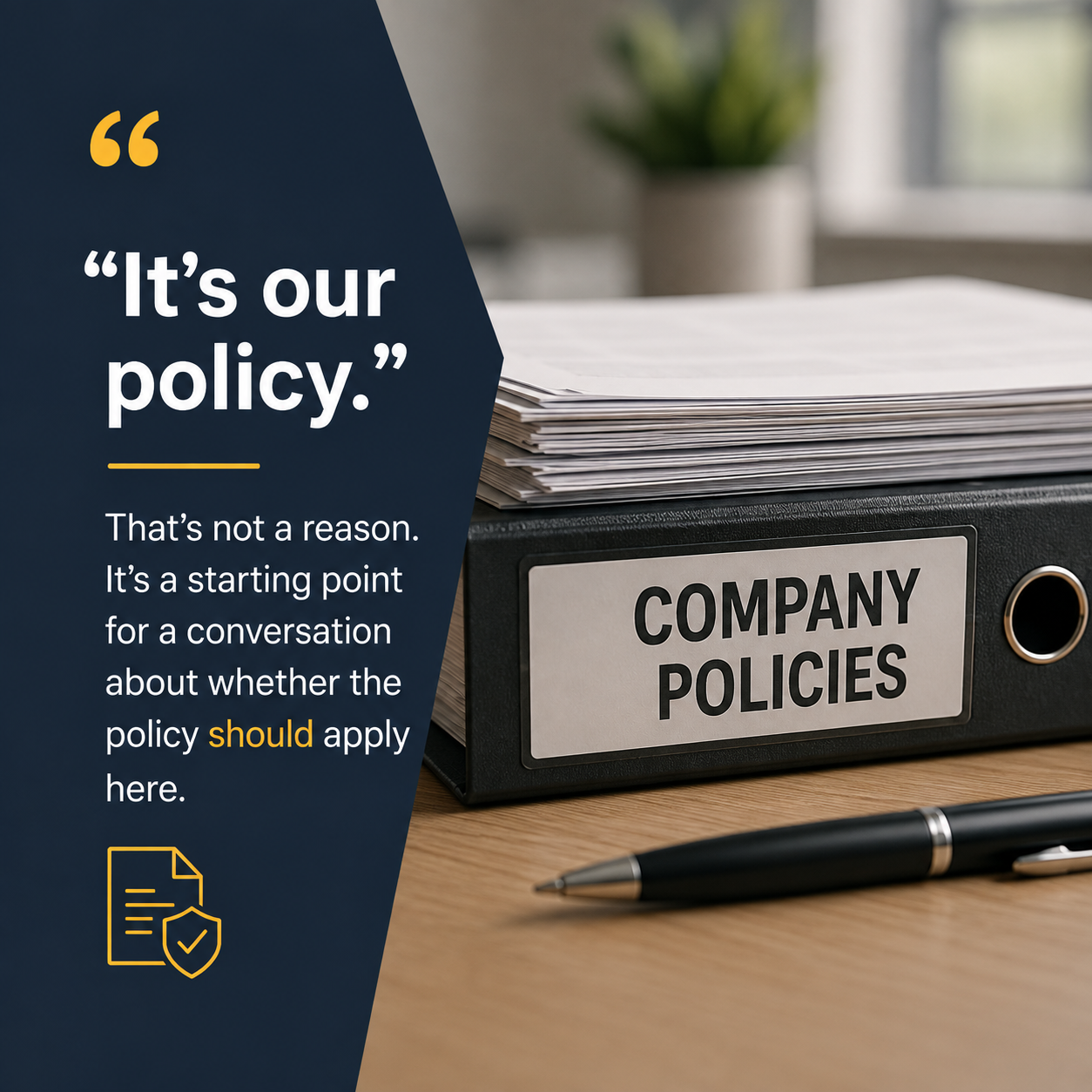
“It’s our policy.”
I hear this constantly in contract negotiations. We can't change the indemnity. We can't change the liability cap. We can't change the payment terms. It's our policy.
Here's the problem: it's very often not true.
There is a big difference between “this is our standard position” and “we can't change it.”
Don't believe me? Spend some time looking at publicly filed agreements on the SEC’s EDGAR website. Large, publicly traded companies agree to terms that depart from their standard positions and policies all the time because different transactions involve different economics, leverage and risk.
Don't get me wrong, contracting policies serve an important purpose. They create consistency, establish negotiating parameters and streamline approvals. But a contracting policy shouldn't become a substitute for negotiation. “It's our policy” shouldn't mean “take it or leave it”, particularly when a reasonable alternative addresses the underlying concern
If a provision doesn't fit the deal or allocates risk disproportionately, push back. Explain why. Give them a reasonable alternative.
I've lost track of how many times “we can't change that” eventually became “let me see what I can do.”
Policy matters. So does reasonableness.