
BLOG FOR ENTREPRENEURS
Trust Stacking and QSBS: Is the Window Starting to Close?
The IRS is looking closely at arrangements designed principally to multiply exclusions without much substance behind separate trusts. Treasury officials have specifically raised concerns about multiple trusts with overlapping beneficiaries.
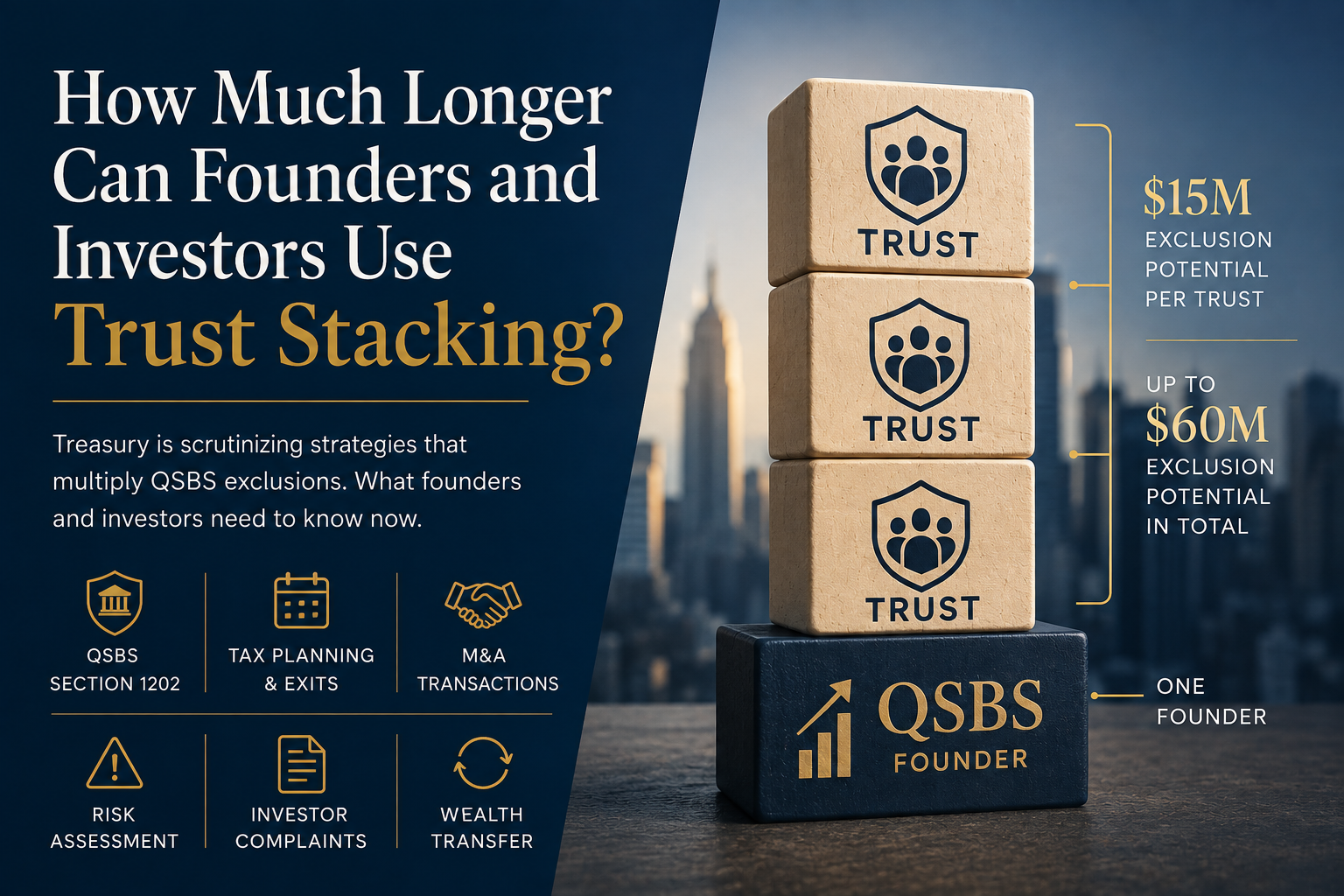
How Much Longer Can Founders and Investors Use Trust Stacking?
Earlier this summer, the Treasury Department cast a spotlight on trust stacking. As reported by The Wall Street Journal, Kenneth Kies, Treasury’s top tax-policy official, warned: “Let me just warn you, we don’t like stacking, OK?” Founders and investors have taken notice.
Since the 1990s, founders and other investors in qualifying startups have been able to shield millions in capital gains on the sale of qualified small business stock (QSBS) under Section 1202. Last year, Congress expanded those benefits under the OBBBA. For qualifying stock acquired after July 4, 2025, investors can potentially exclude up to $15 million of capital gains (or 10x their basis), subject to the applicable holding-period requirements.
Savvy investors have long multiplied those savings through “trust stacking.” For example, a founder could establish separate non-grantor trusts for each of his three children and transfer 25% of his qualifying shares to each. The founder and each trust could potentially qualify for its own $15 million exclusion — $60 million in total.
One interesting feature is that the trusts can generally tack onto the founder’s holding period. A trust receiving QSBS by gift does not necessarily start the clock all over again.
I am a corporate lawyer, not a tax lawyer. But I have represented numerous founders and investors who have taken advantage of QSBS through the sale of their companies. We have also worked with clients who exited one QSBS investment and rolled the proceeds into another under Section 1045. These rules can have an enormous impact on the economics of an exit.
Not surprisingly, a cottage industry has developed around maximizing these benefits, and some strategies are more aggressive than others.
The IRS is looking closely at arrangements designed principally to multiply exclusions without much substance behind separate trusts. Treasury officials have specifically raised concerns about multiple trusts with overlapping beneficiaries.
Timing matters too. If a founder waits until the sale is essentially a done deal before transferring shares to newly created trusts, the IRS may argue that he simply assigned income from an already-fixed sale. As the WSJ notes, advisers are particularly wary once there is a binding commitment to sell.
That does not mean legitimate trust stacking is going away. Separate non-grantor trusts for genuinely different beneficiaries have long been part of estate and QSBS planning. But Treasury has signaled that additional guidance is coming.
For founders and investors holding QSBS, the broader lesson is familiar: planning for an eventual exit should begin well before the exit. If a trust or other wealth-transfer strategy makes sense, establishing it before the shares skyrocket in value — and certainly before the sale process is effectively committed — can make an enormous difference.
Back-Door Unlimited Liability: The Indemnity Trap in Commercial Contracts
There are risks that may appropriately sit outside a general liability cap, such as IP infringement, gross negligence or willful misconduct, for example, and others that may warrant a separate, higher cap.
But that should be intentional, understood and proportionate to the deal, not the unintended result of an overly broad indemnity.
You negotiated a liability cap that you think protects your business and its value.
Then you read the indemnity… Think again.
There’s a back door hiding in plain sight.
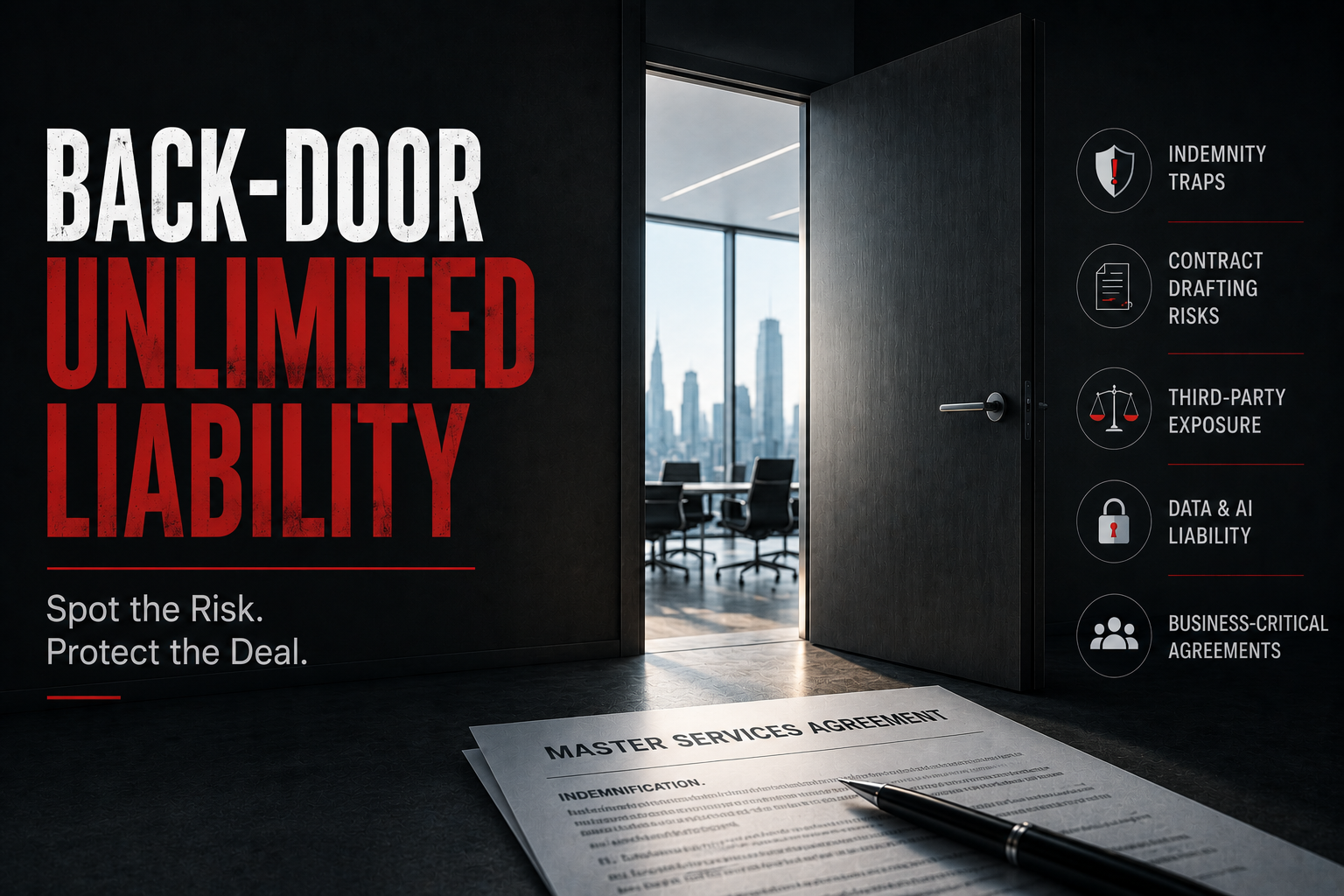
Indemnities are intended to allocate specific risks, often involving third-party claims. But just as often, I see overly broad indemnities covering all losses arising from any breach of the agreement, negligence, or - worse yet - simply as a result of providing the Services.
Then you go back to your hard-negotiated limitation of liability provision and find:
“The foregoing limitation does not apply to Service Provider’s indemnification obligations.”
That’s what I call back-door unlimited liability.
And if you missed it, your carefully negotiated liability cap would be effectively useless.
There are risks that may appropriately sit outside a general liability cap, such as IP infringement, gross negligence or willful misconduct, for example, and others that may warrant a separate, higher cap.
But that should be intentional, understood and proportionate to the deal, not the unintended result of an overly broad indemnity.
So when you negotiate a liability cap, don’t stop there.
Because that’s where back-door unlimited liability is hiding.

The Threat is Coming From Inside the Business
More revenue brings new hires, and new hires can bring... well, sometimes it depends. A recent employee embezzlement case sheds light on the constant focus that CEOs and Founders need to maintain as the enterprise brings in new talent and scales up.
In my work with SMBs, it is genuinely exciting to watch our clients cross new growth thresholds. More revenue brings new hires, and new hires can bring... well, sometimes it depends. A recent employee embezzlement case sheds light on the constant focus that CEOs and Founders need to maintain as the enterprise brings in new talent and scales up.
Pamela Aguilar, 65, the former CFO of a Danbury, Connecticut software company reportedly identified as MaxQ Technologies, pleaded guilty in June to wire fraud after admitting that she stole $739,466.44 from her employer between approximately 2018 and 2025. She used ACH and wire transfers, checks, cash withdrawals, PayPal and credit card payments to divert company money for her own benefit.
What makes the case particularly interesting is how she concealed it. According to the U.S. Attorney’s Office, Aguilar provided the company’s CEO with false weekly cash reports and false monthly financial statements. It wasn't like the CEO had vacated his duty of oversight; rather, the reports themselves were a key part of the fraud. The company's reported annual revenues were in the low single digit millions, meaning that the amount that Aguilar was siphoning off, roughly $9,000/month, may have accounted for 5-8% of monthly revenue. So, just enough to allow her to boost her lifestyle, but also low enough to evade the CEO's notice for several years.
It is a classic controls issue - the executive with access to the company’s money was also providing management with the information it relied upon to determine what was happening to that money. For owners of growing businesses, the lesson is not that you should distrust your CFO. Rather, the question is whether trust is being independently verified.
We constantly work with Founders and Management who get a bad whiff coming from somewhere inside the organization, but may not be confident of how or where to start investigating. In Aguilar's case, she began the scheme very quickly after beginning the job, which is often what we see. It is always a good idea to enlist outside help to poke and prod until you can uncover whether there is a problem. The longer you wait, the worse it gets.

Thibaut Acquires Murphy Bova Client Rosemary Hallgarten Inc.
Thibaut, the 138-year-old fabric, wallpaper and furniture company, has acquired textile brand Rosemary Hallgarten.

The Institutes Acquires Murphy Bova Client Insurance AUM
MALVERN, Pa. (October 1, 2025) — The Institutes, a not-for-profit comprised of diverse affiliates that educate, elevate, and connect people in the essential disciplines of risk management and insurance, have acquired InsuranceAUM.com, a leading digital platform that provides insights, education and networking opportunities within insurance investment. This move marks an important step in broadening the reach and impact of both organizations.

DALS Lighting Acquires Murphy Bova Client Lumenture
DALS announced it acquired Connecticut based Lumenture, a manufacturer known for track and recessed lighting used in commercial and retail environments .